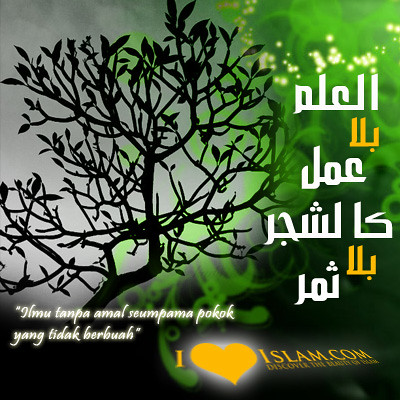
Tugas setiap penuntut ilmu secara umum dapat digariskan sebagai empat tugas iaitu:

Memperbetulkan niat

Perkara pertama yang perlu diambil perhatian oleh penuntu ilmu ialah mempunyai keikhlasan niat demi untuk mencapai keredhaan Allah. Bukan untuk berbangga apabila digelar sebagai orang alim atau dengan tujuan untuk mengumpulkan harta, pangkat atau yang seumpamanya. Sabda Rasulullah SAW : 'Sesiapa yang mempelajari ilmu kerana Allah, tidak mempelajari ilmu kerana inginkan harta dunia, tidak akan dia temui kecuali Syurga hari akhirat kelak.' -Riwayat oleh Abd. Razak.Cuma perlu di ingat bahawa, jika harta, pangkat dan yang seumpamanya datang kepada seorang alim, maka tidaklah menjadi kesalahan untuk menerima dan memanfaatkannya.

Berterusan dalam menuntut ilmu.

Ilmu adalah lautan yang tidak mempunyai pantai dan tepian. Maka usaha menuntut dan menambahkan ilmu hendaklah berlaku secara berterusan, tidak dihalangi oleh peringkat-peringkat ijazah tertentu. Firman Allah SWT. "Katakanlah (wahai Muhammad) tambahkan aku ilmu" (Surah Toha :114)

Sabar dalam menuntut ilmu.

Seorang penuntut ilmu hendaklah sentiasa sabar dalam menempuh dugaan dan cabaran yang merintangi perjalanannya di dalam menuntut ilmu sama ada yang bersifat fizikal mahupun rohani. Tidak perlulah diceritakan di sini sejarah para sahabat dan ulama yang menempuh segala cabaran demi untuk menuntut ilmu.

Memuliakan guru.

Sabda Rasulullah SAW : 'Bukan dari umatku orang yang tidak memuliakan orang tua dan mengasihi anak-anak muda kami dan tidak mempelajari daripada orang-orang alim.' -Riwayat Abu Daud. Saya tidak bertujuan untuk menghuraikan hak seorang alim/guru yang perlu ditunaikan oleh muridnya di dalam artikel ini cuma dicadangkan agar kita mengambil sedikit dari masa kita untuk melihat kembali perkara ini, semoga segala ilmu yang kita tuntut akan mendapat keredhaan Allah SWT.

Akhlak Penuntut Ilmu

1) Merasakan tanggungjawab ilmu
Diriwayatkan daripada Muaz bin Jabal beliau berkata Rasulullah SAW bersabda: 'Tidak akan mara seseorang hamba di hari Akhirat melainkan telah ditanya mengenai 4 perkara: Berkenaan Umurnya ke mana yang telah dia habiskan. Berkenaan dengan Waktu mudanya apa yang telah dia lakukan. Berkenaan dengan hartanya dari mana diperolehinya dan ke mana dia belanjakan. Dan berkenaan dengan ilmu apa yang telah diperbuat dengannya.' -Riwayat oleh Attabarani dengan isnad yang sahih

2) Menjaga amanah ilmiah.
Sabda Rasulullah SAW : 'Berilah nasihat pada ilmu, Sesungguhnya khianat seseorang daripada kamu terhadap ilmu adalah lebih dahsyat daripada khianatnya terhadap hartanya, Dan sesungguhnya Allah akan bertanya kepada kamu pada hari kiamat.' - Riwayat Attabarani-.Di antara yang termasuk dalam daerah amanah ilmu adalah beberapa perkara berikut:-

i)Menasabkan atau menyandarkan pendapat dan fikrah (buah fikiran) kepada Tuannya.
ii)Menyampaikan ilmu yang diketahui, dan tidak malu untuk mengatakan"tidak tahu" jika dia tidak mengetahuinya.

3) Tawadduk.
Para ilmuan yang menyedari bahawa ilmu adalah lautan yang tidak bertepi tidak akan merasa sombong dan bangga dengan apa yang ada pada mereka. Bahkan selagi bertambah ilmu di dada, semakin bertambah sifat tawadduk. Firman Allah SWT: "...Tidak diberi kepada kamu ilmu kecuali sedikit sahaja." (Surah al-Isra':85)

4)Mulia diri (Al-Izzah)
Para ilmuan hendaklah merasa mulia diri dan tidak merendahkan diri apabila berhadapan dengan pemerintah, golongan bangsawan, golongan kaya-raya dan yang seumpamanya. Firman Allah SWT: "Kekuatan itu hanyalah kepada Allah, bagi RasulNya dan bagi orang-orang mukmin, tetapi orang-orang munafik itu tidak mengetahui." (Al-Munafikun:8) , "Barangsiapa yang menghendaki kemuliaan, maka bagi Allah lah kemuliaan itu semuanya." (Fathiir:10)

5)Beramal dengan apa yang dipelajari.
Firman Allah SWT : "Mengapa kamu menyuruh orang lain (mengerjakan) kebajikan, sedangkan kamu sendiri melupakan diri (kewajiban)mu sendiri padahal kamu mambaca Al-Kitab (Taurat)? Maka tidakkah kamu berfikir?" (Al-Baqarah:44)

6)Sentiasa berusaha untuk menyampaikan ilmu.
Firman Allah SWT: "Dan (ingatlah) ketika Allah mengambil janji dari orang-orang yang telah diberi kitab (iaitu):"Hendaklah kamu menerangkan isi kitab itu kepada manusia, dan janganlah kamu menyembunyikannya", lalu mereka melemparkan janji itu ke belakang punggung mereka dan mereka menukarkannya dengan harga yang sedikit,amatlah buruk tukaran yang mereka terima." (Ali-Imran:187)

**dipetik drpd laman iluvislam.com

Salam ukhuwwah dan salam kasih sayang...
di kesempatan ini, ana ingin mengucapakan kepada semua bekas Pelajar SMUK yang berada di seantero ipt kini yang ana kira akan berhadapan dengan final exam, dan juga yang sedang menghadapi final exam saat ini, ana mewakili PERKASIH mengucapkan bittaufik wannajah kepada semua.Moga usaha kita membuahkan hasil.
Best of Luck...May All with us always...


hasil design salah sorang ex-student smuk..ust Fauzi hamid..(",)


Dah lama rasa nak berkongsi perisian Mushaf Raqmi ini, Alhamdulillah tercapai juga hari ini. Perisian Quran Mushaf Raqmi ini penulis dapat dari roomate penulis dulu masa tahun dua lalu, orang Syiria... (terima kasih Badruddin), dialah yang memperkenalkan perisian ini kepada penulis.

Apa KELEBIHAN perisian Mushaf Raqmi 1.0???
Kelebihan perisian ini adalah ianya mempunyai kandungan al-Quran yang sempurna pada saiznya yang kecil iaitu hanya 1.25MB, dan diedarkan secara percuma kepada semua pengguna oleh Kementerian Pendidikan Arab Saudi.

Untuk memudahkan penggunaannya, perisian ianya dibahagi pada dua bahagian,
1) Bahagian untuk carian perkataan atau ayat;
2) Bahagian senaraian surah-surah al-Quran.
3) Bahagian Tafsir

Melalui perisian ini juga, anda boleh mencari perkataan dan ayat di dalam al-Quran, selepas perkataan atau ayat yang akan dicari diisi dalam kotak carian yang disediakan, dalam masa kurang 10 saat sahaja, keputusannya akan dapat disaksikan di paparan monitor anda.

Manakala senaraian surah-surah pula memudahkan pengguna untuk mencari surah mengikut turutan dalam al-Quran.

Mushaf Raqmi 1.0 didatangkan bersama dengannya juga adalah dua tafsir yang muktabar iaitu Tafsir Jalalain dan Tafsif Muyassar dan semestinya di dalam bahasa Arab.

-Screenshot-


MUAT TURUN MUSHAF RAQMI 1.0


Penting!
Tidak semua komputer boleh menggunakan perisian ini, melainkan komputer yang digunakan telah di "set" ke mode "Arabic". Untuk proses Setting Arabic sila rujuk sini.

Sumber- MofiR

Assalamualaikum Warahmatullah Wabarakatuh.

Saya bagi pihak admin memohon ribuan kemaafan disebabkan tidak mengemaskini laman blog perkasih ini. Buat masa ini, untuk pengetahuan pengunjung semua, admin blog ini hanyalah tiga orang iaitu saya dan Mohd Fauzi Abdul Hamid dan Mohd Lukman Mat Isa. Kami masing-masing mempunyai komitmen sendiri sehingga terlepas pandang untuk mengemaskini laman blog ini.

Kepada sesiapa yang mempunyai maklumat / perancangan / perkembangan semasa dan apa sahaja mengenai program terbaru yang akan melibatkan ahli-ahli PERKASIH diminta untuk emelkan kepada kami supaya kami boleh update blog ini dari masa ke semasa.

Sokongan anda untuk melihat kegemilangan SMUK amatlah dihargai, kami dahulukan dengan ucapan jutaan terima kasih atas keperihatinan anda.

Terima kasih.
Wassalam.

MOHD FIRDAUS BIN YAHAYA
Admin.
emel - perkasihsmuk[at]yahoo.com


Understanding Politics in Islam - Fiqh al Siyasah Adapted and rearranged from the book Fiqh al-Dawlah written by Professor Yusuf al Qaradawi.
1. What is the aim of politics in Islam?

According to Al-Mawardi from his book Al-Ahkam Al-Sultaniyyah, it is hirasatud din wa siasatud dunya - to uphold the religion and administer the world. Politics is not munkar - is not a depravity - real politics is noble virtuous because it administers the affairs of all creatures, bringing man closer to good and away from fasad - evil. According to Ibn al-Qayyim, politics is really the justice of Allah the Almighty and His Prophet (peace and the blessings of Allah be upon him). The Prophet Muhammad s. a. w. was a politician as well as the messenger conveying the risalah, murabbi - teacher, Qadi - Chief Justice, Head of the nation and Imam of the ummah. The Khulafa' al Rasyidun - the rightly guided leaders who succeeded him were also politicians following the Sunnah - way of the Prophet, establishing just administration, practising ihsan - the betterment of good and providing the leadership of 'ilm - knowledge and Iman - belief.

However in the present time, due to 'politics' man faced suffering as a result of deceit and political ploys and scheming and devious politicians, whether in the form of past colonialists, treacherous rulers, tyrannical leaders and regimes preaching Machiavellian philosophy (the ends justifies the means!). It became common to label and describe committed Muslims as 'political' so that they are regarded warily and wickedly for the purpose of disassociating and furthering apart the people from them, intending that society will shun and hate what is called 'political Islam'. It has been such that symbols of Islam like the headscarf, the proper attire and congregational prayers - Salat jama'ah are attempted to be labelled 'political'. It is a blatant lie for those who say that there is no religion in politics and that there is no politics in religion. This deceit was once tried in the form of an attempted fatwa - a decree while the members of the Ikhwan al-Muslimun were imprisoned in the detention camps in Egypt in the 50's. The regime wanted to influence the masses to regard the activists and the Dai' (the very people who wanted to uphold the Syari'ah, Al-Qur'an and Al-Sunnah) as the purveyors of fasad - evil by using corrupted 'ulama - paid scholars.
2. The Fight against Fasad and Zulm (Evil, Transgression and Tyranny) is the utmost in Jihad

From the understanding of the Prophet's tradition (mafhum hadith): Munkar (transgression) is not limited to khamr - liqour, gambling and zina - - unlawful sex but degrading and defiling the honour and dignity of the people and citizens is a major transgression, so is cheating in the elections, refusing to give testimony - neglecting to vote, letting government be in the hands of those who are not deserving and undesired, stealing and squandering the nation's wealth and property, monopolising the people's needs for personal gains or cronies' interests, detaining people without crime or just cause, without judgement from a fair court, torturing human beings in prison and the detention camps, giving, accepting and mediating in bribes, cowering up to, praising evil rulers, allowing the enemies of Allah and the enemies of the Muslim community to be leaders and shunning the believers - the mu'min. These are all grave transgressions! When a Muslim remains quiet upon seeing all of these it means that he or she does not deserve to live
(is not alive) from the mafhum of al-ayat and al-hadith.

Islam requires that every Muslim has political responsibility. A Muslim is required by his Iman - faith to be truly concerned with the affairs and problems of the ummah - community, helping and defending the meek and the weak, fighting tyranny and oppression. By retreating and abstaining oneself, it will only invite divine retribution and being seized by the flames of hell (mafhum ayat).
3. Political Freedom is Our Utmost Need Today

Islam is always rejuvenated, its message spread across, its resurgence, its reverberating call heard by all even if it is given some limited freedom. Therefore the first battle is to obtain freedom to deliver the message of da'wah, the risalah of tawhid (Unity of God), spread consciousness and enabling the existence of Islamic movements. True democracy is not the whims and desires of the tyrannical rulers or their cronies, it is not the place to jail and incarcerate its fighters and not the place to torture its proponents.

Democracy is the simplest and proper way to achieve the aims of a noble life, to be able to invite all to Allah and Islam, to be able to call others to Iman without having our souls being imprisoned and our bodies sentenced to be executed by hanging. It is the space for a free and honourable nation to have the right to choose, evaluate the ruler, change governments without coups and without bloodshed. The theory, way and system which looks alien maybe adopted if it benefits us and as long as it does not contradict clear Islamic edicts and the rules of Syariah. We appraise, amend according to our spirit, we do not adopt its philosophy, and we do not allow what is forbidden and vice versa. We do not relinquish or compromise what is ordained or compulsory - the wajib in Islam. The gist of democracy is that the public, the people can choose the rulers who are going to administer them; the people having the right to select, criticise and terminate; and the people are not forced to accept systems, trends, and policies which they do not agree to and they are not abused. They are free to hold elections, referendums, ensuring majority rights, protecting minority rights, having opposition, have multi parties, have press freedom and safeguarding the independence of the judiciary. But once again to constantly uphold and safeguard the principles of Islam, the firm rulings, the al-thawabit: the determined laws - hukm qat'i, the daruri - the essentials of religion and the non-ijtihadiy must not be compromised or neglected.

Syura: Syura or consultative decision making must be followed and not just as a debating factor. By practising syura, it is closer, hence even better than the spirit of democracy. It is but the lost jewel found, the lost wisdom - al-hikmah which has been rediscovered. Syura enables musyawarah to be conducted, obtains views and opinions, becomes the responsibility of the people to advise and counsel the government (ad-dinu nasiha) and establish amar ma'ruf nahy munkar - enjoining good and forbidding evil. Among the obligations of amar ma'ruf nahy munkar is the highest jihad (struggle) that is to voice out the truth in front of the unjust tyrant. The State of Politics in the Ummah:

The musibah or calamity of the ummah then and now is the absence and the abeyying of the system of syura and the adoption of an oppressive dynastical ruling system. In the modern era, dictators stay in power by the force of arms and gold - power and wealth resulting in the syariah being hindered, secularism being forced upon and cultural Westernisation being imposed. Islamic da'wah and the Islamic movement being victimised, brutalised, imprisoned and hounded viciously.

4. Qur'anic Examples of Tyrannical Rulers The Al-Qur'an denounces all powerful rulers such as Namrud, Fir'aun (Pharaoh), Hamaan and Qarun. Namrud is taghut - the transgressor who enslaves the servants of Allah as his serfs.

There is the pact or collaboration of three parties: Fir'aun - he claims to be God, carries out tyranny and oppression throughout the land, enslaves the people Hamaan - the cunning politician, experienced, having self interest, in the service of taghut, propping up and supporting Fir'aun and cheating the people, subjugating them. Qarun - the capitalist or feudalist who takes opportunity from the unjust and oppressive laws, spending fortunes for the tyrannical leader in order to profit and amass more vast returns, bleeding and exploiting the toils of the people. The origin of Qarun was that he came from Prophet Musa's own clan who colluded with Fir'aun due to the love of worldly life and materialism. The combination of taghut and Zulm results in the spread of mayhem and the destruction of the community, subjugating man by force and degradation. The People:

Al Qur'an denounces the people or citizens who are obedient and loyal to their oppressive rulers. The people who remain under the tutelage of taghut are fully responsible and accountable because it is due to their attitude that brought forth these fir'auns and taghuts. Al-Junud (the collaborators): These are the armies and enforcers of the rule and order of the taghut. They use force, fear and repression to eliminate and subdue all opposition and dissidents of the tyrant.
5. An Example of Leadership

Balqis, the Queen of Saba' as told in the Qur'an was a woman who lead her people well, just and administered them with intelligence and wisdom saving her people from a war that was destructive and made decisions by syura-consulting them. Alas, the story ended with the acceptance of Islam. She led her people towards the goodness of the world and the hereafter. Leaders like her are much more capable and qualified with political acumen and wise administration than most of the present Arab and Muslim 'male' leaders. (Prof. Yusuf Qaradawi purposely avoided the term 'al-rijal')
6. Pluralism and Multi Parties in Islam

The existence of various parties or movements is not forbidden as long as unification is not achievable due to differences over objectives, approaches, understanding and the level of confidence and trust. Variety and specialisation are allowed as long as they do not become contradictory and confrontational. However everyone has to be in one united front when facing the challenges to aqidah - belief, syariah, ummah and the survival of Islam. Relations between parties and groupings should be in the atmosphere of non-prejudice, forgiveness, nobleness, counselling truth and steadfastness, wisdom and engaging in healthy cordial debate. Even when the Islamic State is established there is no reason to feel distraught at the existence of pluralism and differences.
7. Counselling and Corrective Participation in Politics

Without the shedding of blood, the most effective way as the outcome of long and painful struggles is the existence of political forces which the government in power is unable to contain or eliminate: that is presence of political parties. The ruling regime can get rid of individuals and small groups of opponents but it is difficult for them to defeat or wipe out larger organisations which are well structured, organised and rooted in the masses of society. Political parties have the platform, machinery, newspapers and publications as well as mass influence. Political parties or political movements are necessary to fight oppression, to enable criticism, bringing back the government to to uphold truth and justice, bringing down or changing the government. These parties are capable of monitoring and appraising the government, offer advice and criticism.
8. Voting

Voting in the elections is a form of testimony. A just testimony is considered as long as one is not convicted of crime. Whoever so votes or abstains from voting in the general elections causing the defeat of a trustworthy and deserving candidate but on the other hand allows the candidate who is less trustworthy and undeserving to win, one has gone against the command of Allah concerning giving testimony.

ASSALAMUALAIKUM...Pihak blogmaster memohon kemaafan kerana bahan yang masih kurang untuk dimuatkan dalam web ini...Justeru, dipohon agar semua sahabat dapat menghantar sebarang kiriman berbentuk berita, karya, dan lain-lain demi memeriahkan web ini..Juga sebarang cadangan, jangan lupa, shoutkan di ruang yang disediakan....Sekian, terima kasih.

Memperkenalkan, web terbaru untuk warga Sek. Men. Agama Al-Khairiah khususnya PERKASIH yang merupakan persatuan yang diterajui oleh bekas pelajar SMUK. Memandangkan mysmuk.net telah lama hilang, kini web baru khas untuk semua warga SMUK mendapatkan info terkini serta berkongsi sebarang maklumat antara kita semua. Selamat melayari semua....

Photobucket

PENGUNJUNG


SEJAK 23 SEPTEMBER 2009
Photobucket

MUTIARA KATA

PESANAN MAYA

KATEGORI

HARI INI

SEBARKAN

Persatuan Bekas Pelajar SMA Al-Khairiah

Sila Copy coding di bawah dan Paste di laman anda utk membuat pautan ke laman ini. Terima Kasih.

PAUTAN BERGAMBAR